
Most are short visits of 30 to 60 minutes, so you can combine several in half a day.
Near the Sangam
Bade Hanuman Ji, with its large reclining image, is the best known. Shankar Viman Mandapam, a tiered temple in the South Indian style, and Mankameshwar on the Yamuna bank can be added easily. In a high-flood season the lower areas near the river may be affected.
Alopi Devi and the old city
Alopi Devi Mandir is unusual because the sanctum holds a palanquin rather than a sculpted image. It sees large crowds during Navratri.
Visiting tips
- Remove footwear and dress modestly.
- Tuesdays and Saturdays are busy at Hanuman shrines.
- Mondays and Shravan are busy at Shiva temples.
- Avoid peak Mela days unless you have planned for them.
Prayagraj at a glance
- Spiritual 2–3 hours
Triveni Sangam
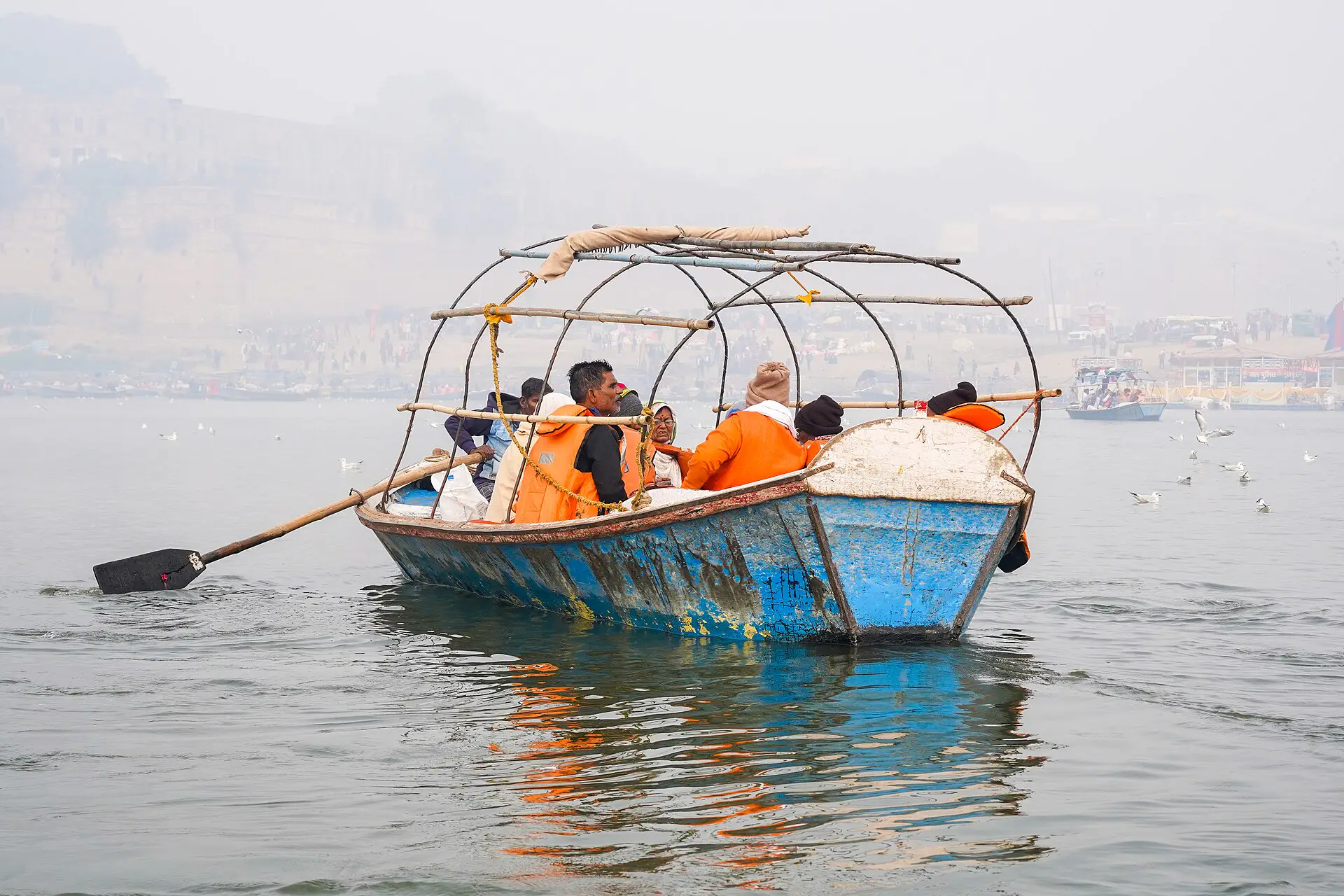
The confluence of the Ganga and Yamuna, reached by boat from the ghats near the Fort for a holy dip or prayers.
Why it is specialHindu tradition calls Prayag Tirtharaj, the king of pilgrimage places. The meeting of the Ganga, the Yamuna and the unseen Saraswati is the focus of the Kumbh and Magh Melas, among the largest religious gatherings in the world.
Sangam Kshetra, near Prayagraj FortModerate walkingEarly morning is calmer and cooler. River levels change with the season and boat fares are negotiated, so agree before boarding. Restrictions apply in Mela periods.
- Temple 30–60 minutes
Bade Hanuman Ji Temple
A well-known temple with a large reclining Hanuman image, close to the Sangam and visited by almost every pilgrim.
Why it is specialThe image lies on its back, partly below ground level, which is rare for Hanuman. Devotees believe that when the Ganga rises and reaches the idol, Mother Ganga is touching Hanuman's feet, so the flood is greeted as auspicious.
Near Sangam, PrayagrajEasy walkingIn high-flood years the lower areas near the river can be affected. Tuesdays and Saturdays are busier.
- Heritage 1 hour
Prayagraj Fort and Akshayavat
A large sixteenth-century Mughal fort on the Yamuna, associated with the Patalpuri temple and the Akshayavat tree.
Why it is specialAkbar built the fort in the 1580s at the confluence. Within its walls are the Akshayavat, the 'imperishable banyan' of tradition, the underground Patalpuri temple, and an Ashokan pillar that also carries Samudragupta's famous inscription.
Sangam KshetraModerate walkingMuch of the fort is under military control and public access is limited. Check what is open before planning.
- Museum 1.5–2 hours
Anand Bhawan and Swaraj Bhawan
The Nehru family home and an adjacent house, now museums on the freedom struggle and family history.
Why it is specialAnand Bhawan was the Nehru family home and a meeting place for leaders of the freedom movement. The older house, renamed Swaraj Bhawan and given to the Indian National Congress, is where Indira Gandhi was born.
Civil Lines area, PrayagrajEasy walkingCheck weekly closing days and entry rules before you go.
- Museum 1.5–2 hours
Allahabad Museum
A large museum with sculpture, terracotta, paintings and a section on modern Indian history, set in Chandrashekhar Azad Park.
Why it is specialOne of India's major museums, it is known for early terracotta and sculpture from Kaushambi and other sites in the region, miniature paintings, works by Nicholas Roerich, and freedom-movement memorabilia including Chandrashekhar Azad's pistol.
Civil Lines, PrayagrajEasy walkingCheck opening days and ticket rules before visiting.
- Temple 30–45 minutes
Alopi Devi Mandir
A shaktipeeth-linked temple where the deity is worshipped in an unusual form, with a palanquin rather than an image at the sanctum.
Why it is specialDevotees regard it as a Shaktipeeth where, according to one tradition, the last part of Sati's body vanished (alop), giving the temple its name. That is why a wooden doli, or palanquin, is worshipped in place of an idol.
Alopibagh, PrayagrajEasy walkingNavratri brings heavy crowds.
- Temple 30–45 minutes
Mankameshwar Temple
An important Shiva temple on the Yamuna bank near the Fort, often visited with the Sangam.
Why it is specialThe name means 'the lord who fulfils the wishes of the heart', and devotees come here to pray for personal wishes. It is counted among the old Shiva shrines of Prayag and sits close to Saraswati Ghat on the Yamuna.
Near Yamuna ghatEasy walkingMondays and Shravan draw larger crowds.
- Temple 30–45 minutes
Shankar Viman Mandapam
A tall multi-tiered temple in South Indian style near the Sangam, with sculpted panels and a calm setting.
Why it is specialDedicated to Adi Shankaracharya and linked with the Kanchi Kamakoti Peetham, it brings South Indian temple architecture to the Sangam. Its storeys hold separate shrines, including Kamakshi Devi and Balaji, and the upper floors look out over the rivers.
Near Sangam, PrayagrajEasy walking - Heritage 45 minutes–1 hour
Khusro Bagh
A walled Mughal garden holding the tombs of Khusrau Mirza and other royal women, with fine arches and old trees.
Why it is specialKhusrau, Jahangir's eldest son, rebelled against his father and died in captivity in 1622. The garden also holds the tomb of his mother, Shah Begum, and one usually attributed to his sister, a fine set of early Mughal tombs.
Near Prayagraj JunctionEasy walkingClose to the station, so it suits a layover.
- Spiritual 30–45 minutes
Bharadwaj Ashram
A temple complex marking the traditional site of Rishi Bharadwaj's hermitage, with shrines to the sage and to Shiva.
Why it is specialTradition holds that Rishi Bharadwaj ran a great centre of learning here, and the Ramayana tells how Rama, Sita and Lakshmana stopped at his ashram on their way into exile. It is one of Prayag's oldest remembered sacred sites.
Colonelganj, near Anand BhawanEasy walkingIt is a short drive from Anand Bhawan, so the two pair well. Expect a modest, quiet site rather than a grand monument.
- Temple 30–45 minutes
Nag Vasuki Temple
An old temple to Vasuki, king of the serpents, on a high bank of the Ganga at Daraganj, north of the Sangam.
Why it is specialIt is one of the few temples devoted to Vasuki, the serpent used as the churning rope in the Samudra Manthan. Devotees traditionally see a visit here as completing the Prayag pilgrimage, and Nag Panchami draws large crowds.
Daraganj, PrayagrajModerate walkingBusiest around Nag Panchami and during the Mela. There are some steps from the road, and the lanes of Daraganj are narrow.
- Temple 30–45 minutes
Lalita Devi Temple
A large Devi temple in the Meerapur area of the old city, counted by devotees among the Shaktipeeths of Prayag.
Why it is specialAccording to tradition, the fingers of Sati fell here, and devotees regard it as Prayag's Shaktipeeth alongside the Alopi Devi tradition. Many pilgrims visit both temples on the same day, especially during Navratri.
Meerapur, PrayagrajEasy walkingNavratri brings heavy crowds. The old-city lanes are narrow, so an auto or e-rickshaw is easier than a car.
- Temple 45 minutes–1 hour
Someshwar Mahadev Temple, Arail
A Shiva temple on the south bank of the Yamuna at Arail, across the river from the Sangam and the Fort.
Why it is specialTradition holds that Soma, the Moon god, worshipped Shiva here to be freed from a curse, which gives the temple its name. It is part of the old pilgrim circuit on the quieter Arail side of the confluence.
Arail, across the YamunaModerate walkingReached by road over the Yamuna bridges, or by boat from the Sangam side. Access arrangements change during Mela periods, so check locally.
- Heritage 30–45 minutes
All Saints Cathedral (Patthar Girja)
A large Gothic Revival church at a roundabout in Civil Lines, built of cream and red stone and still in use for worship.
Why it is specialDesigned by the British architect William Emerson and consecrated in the late nineteenth century, it is among the finest colonial-era churches in north India. Locals call it Patthar Girja, the stone church.
Civil Lines, PrayagrajEasy walkingIt is a working church, so dress modestly and keep quiet during services. The interior may not be open outside service times.
- Heritage 20–30 minutes
Madan Mohan Malaviya Park (Minto Park)
A riverside park with a memorial column, close to the Yamuna and Saraswati Ghat.
Why it is specialIn 1858 Lord Canning read out Queen Victoria's proclamation here, marking the transfer of rule from the East India Company to the British Crown. The park is now named after the educationist and freedom fighter Madan Mohan Malaviya.
Near Saraswati Ghat, on the YamunaEasy walkingA short stop that combines easily with Mankameshwar Temple and Saraswati Ghat.
- Spiritual Half a day including the drive
Shringverpur
A riverside village on the Ganga linked with Nishadraj Guha, with temples, a ghat and excavated ancient remains.
Why it is specialIn the Ramayana, Rama, Sita and Lakshmana crossed the Ganga here with the help of the boatman-king Nishadraj Guha, whose friendship with Rama is widely remembered. Excavations have also uncovered ancient settlement layers and a large brick tank.
Roughly an hour by road north-west of PrayagrajModerate walkingPlan it as a half-day trip by car. Facilities are basic, so carry water, and take care on the ghat steps when the river is high.
Frequently asked questions
Which temple should I not miss?
Bade Hanuman Ji is usually paired with the Sangam. Alopi Devi adds a distinctive sacred site.
Is there a darshan fee?
Most temples are free, though some have optional special darshan arrangements. Confirm locally.
Can I cover temples in half a day?
Yes. A morning is enough for the Sangam-side temples, and Alopi Devi can follow in the afternoon.