
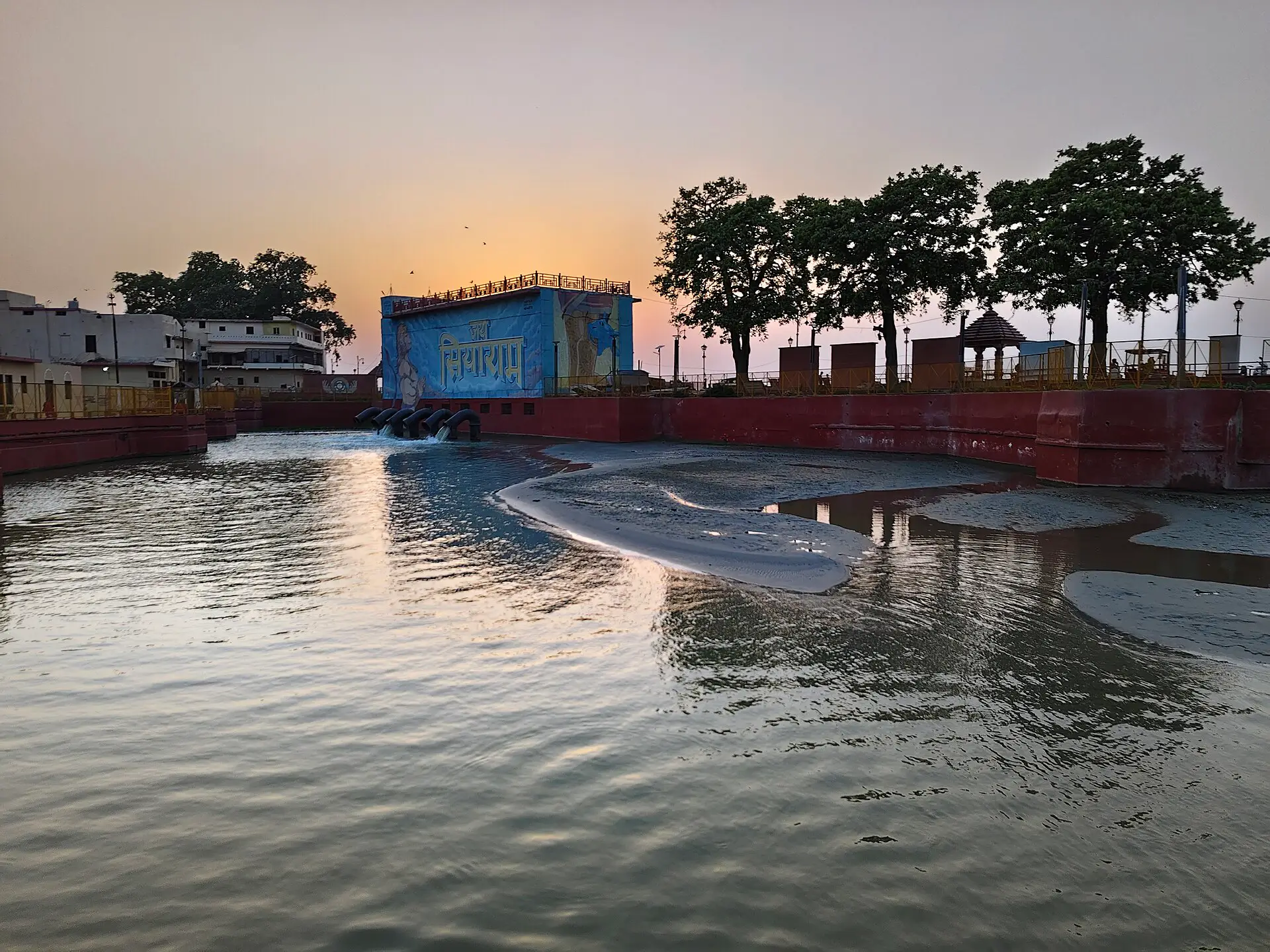
For travellers who like to begin and end the day by the water, this is a pleasant base. The main temples are a short ride inland, while older shrines such as Nageshwarnath and Treta Ke Thakur sit close to the ghats. Below we look at what the riverside is like, where to stay and how to get about.
What the Naya Ghat riverfront is like
The riverfront has been landscaped in recent years, with wide steps, lighting and open promenades that fill up around sunrise and sunset. Ram Ki Paidi is the focal point for Deepotsav, when the steps are covered with lamps, and for regular evening aarti on the Saryu.
Behind the ghats lie older mathas, small temples and narrow lanes that feel very different from the new boulevards. Boating on the Saryu is commonly available, though it depends on water levels and local rules.
Staying near Naya Ghat
SwagatGo does not list hotels or prices. Around the ghats you will mostly find dharamshalas, ashram rooms and smaller guest houses rather than large hotels. A river-facing room can be lovely, but ask how the building is reached, as some approaches are through narrow lanes or steps.
- Best for: early-morning snan, evening aarti and a calmer evening than the Mandir zone
- Expect very heavy crowds and traffic restrictions around Deepotsav and major snan days
- Families with older members should check for steps between the drop-off point and the room
Getting around from Naya Ghat
- Ram Ki Paidi, Nageshwarnath Temple and Treta Ke Thakur are generally walkable from the ghats
- Shri Ram Janmabhoomi Mandir and Hanuman Garhi are usually about 10 to 25 minutes away by e-rickshaw along Ram Path, longer on crowded days
- Guptar Ghat lies downstream on the Faizabad side and is easiest by car or auto
- Ayodhya Dham Junction is typically a short drive inland; allow a margin for traffic near the river
Food and daily needs by the river
Tea stalls, chaat counters and sweet shops gather near the ghat approaches, and simple vegetarian eateries serve thalis and puri-sabzi. Flower, diya and pooja-item sellers line the steps, which makes it easy to pick up offerings for the aarti. For larger shopping or medical needs, Ram Path and Faizabad have more choice.
Temples and places near Naya Ghat and Ram Ki Paidi
- Ghat 1–2 hours
Ram Ki Paidi
The landscaped series of ghats on the Saryu, where pilgrims bathe, pray and gather for evening aarti.
Why it is specialA bath in the Saryu is believed to wash away sins, and these steps give pilgrims easy access to the river. Ram Ki Paidi is also the main stage of Deepotsav, when lakhs of earthen lamps are lit along the banks around Diwali.
Saryu riverfrontEasy walkingEvenings are atmospheric; water levels and bathing arrangements change with the season, so follow local guidance.
- Temple 30–45 minutes
Nageshwarnath Temple
A Shiva temple regarded in local tradition as among Ayodhya's oldest, close to the Saryu.
Why it is specialLocal tradition says Kush, son of Ram, founded this temple for a Naga princess devoted to Shiva, who had returned an armlet he lost in the Saryu. It is a major focus of worship on Mahashivratri.
Near Ram Ki PaidiEasy walking - Spiritual 30 minutes
Treta Ke Thakur
A temple on the Saryu bank linked to the memory of the Ashwamedha yagna of Shri Ram, with a quiet riverside setting.
Why it is specialTradition holds that Shri Ram performed the Ashwamedha yagna at this spot. The name recalls the Treta Yuga, the age of the Ramayana, and the temple's images of Ram and his brothers are held in special regard by devotees.
Kaleram Mandir area, Saryu bankEasy walking - Temple 20–30 minutes
Choti Devkali Temple
A modest temple of the goddess in the old town, quieter than the main shrines and visited mainly by local devotees.
Why it is specialAccording to tradition, Sita brought the image of her family goddess, Gauri, from Janakpur when she married Ram, and it was installed here. Devotees regard her as Ayodhya's protective goddess.
Old Ayodhya, towards the SaryuEasy walkingIt sits in narrow lanes, so an e-rickshaw is the easiest way to reach it. It pairs well with a morning at the ghats.
- Temple 1 hour
Hanuman Garhi
A fort-like hilltop temple of Hanuman, traditionally visited before Ram darshan, reached by a flight of steps.
Why it is specialAccording to tradition, Hanuman lived here to guard Ayodhya, which is why devotees seek his blessing before Ram darshan. The fortified temple seen today is generally linked to the 18th century, when it grew under Awadhi patronage.
Hanuman GarhiModerate walkingSteps lead up to the main shrine and the lanes get crowded, especially on Tuesdays and Saturdays. Elders should go at a quiet hour and take support.
Other areas to stay in Ayodhya
Near Ram Mandir and Ram Janmabhoomi path
Best for: Short pilgrimages, senior citizens, early-morning darshan
Stays here save the most travel time on darshan day, but vehicles are restricted close to the complex, so a stay can still involve a short walk or e-rickshaw ride. Demand is highest here and options are limited.
Nearby: Shri Ram Janmabhoomi Mandir · Hanuman Garhi · Kanak Bhawan
Hanuman Garhi and Ram Kot
Best for: Travellers wanting a traditional temple-town atmosphere
Narrow lanes, old dharamshalas and many small shrines. Good for those who want to be close to several temples, though access by car can be tight.
Nearby: Hanuman Garhi · Kanak Bhawan · Dashrath Mahal
Ram Ki Paidi and Saryu riverfront
Best for: Evening aarti, photography, relaxed stays
A more open, quieter setting with river views in places. A reasonable choice for families who value evenings by the water.
Nearby: Ram Ki Paidi · Nageshwarnath Temple · Ram Katha Park
Railway station area
Best for: Late-night or early-morning train arrivals, one-night stops
Practical for rail travellers and has a good range of straightforward stays. The temples are a short drive away rather than a walk.
Nearby: Ayodhya Dham Junction
Faizabad and the highway belt
Best for: Groups with cars, easier parking, larger rooms
Further out, with more space and easier road access, and better when you are travelling by your own vehicle or in a larger group.
Nearby: Bahu Begum Ka Maqbara · Guptar Ghat
Frequently asked questions
Is Naya Ghat the same as Ram Ki Paidi?
They are neighbouring parts of the same riverfront. Naya Ghat is the main ghat on the Saryu where Ram Path ends, and Ram Ki Paidi is the series of steps and channels beside it where Deepotsav and the evening aarti are centred.
Is it safe to bathe in the Saryu at Naya Ghat?
Many pilgrims take a dip at the designated bathing steps. Stay within marked areas, avoid going deep, and take extra care during the monsoon when the current can be strong. Follow any instructions from local staff or police.
When is the best time to visit the ghats?
Early morning is calm and good for snan and photographs, while the evening brings the aarti and larger crowds. Winter mornings can be foggy, so keep the plan flexible.