
For the temple-dense town of Banke Bihari, Radha Raman and Prem Mandir, see our Vrindavan guides.
Core temples in Mathura town
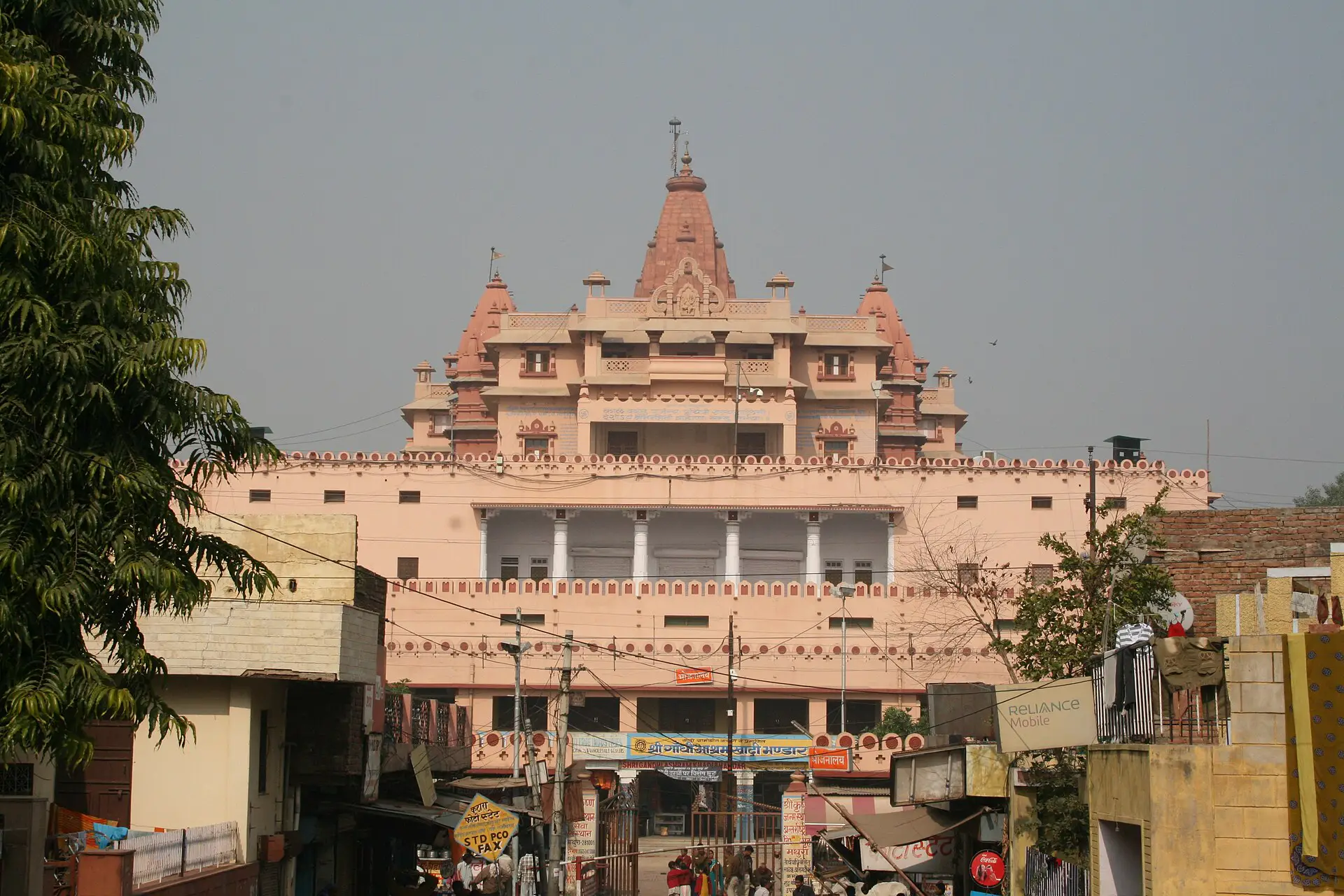
- Shri Krishna Janmabhoomi: the traditional birthplace, with strict security.
- Dwarkadhish Temple: known for decorated darshans and festival atmosphere.
- Vishram Ghat shrines: small temples along the riverfront, best around the evening aarti.
Temples beyond the town
Etiquette and practical tips
- Dress modestly, and expect to remove footwear.
- Carry little. Phones and bags are restricted at some sites.
- Temple timings change by season and festival. Confirm them locally before you plan.
- Go early on weekends and holidays to avoid crowds.
Mathura at a glance
- Temple 1.5 to 2.5 hours
Shri Krishna Janmabhoomi
The traditional birthplace of Krishna, with a temple complex that includes the prison-cell shrine and the Keshav Dev area.
Why it is specialDevotees believe Krishna was born here to Devaki and Vasudeva in the prison of the tyrant king Kansa. The site has been venerated for many centuries and is one of the holiest places in the Vaishnava world.
Janmabhoomi RoadModerate walkingSecurity is strict. Mobile phones, bags and electronics are generally not allowed inside, and lockers or deposit counters are usually available nearby. Check current rules before you go.
- Temple 1 to 1.5 hours
Dwarkadhish Temple
A beloved old-city temple known for its decorated darshans, haveli-style architecture and festival atmosphere.
Why it is specialBuilt in the early nineteenth century and served in the Pushti Marg tradition of Vallabhacharya, it worships Krishna as the king of Dwarka. It is especially loved for its swing festival during the monsoon month of Shravan.
Old City, near Vishram GhatModerate walkingGets very busy during Janmashtami, Holi and Jhulan season. Darshan timings and any restrictions change, so confirm locally.
- Ghat 1 to 2 hours
Vishram Ghat
The principal ghat on the Yamuna, where pilgrims bathe, rest and attend the evening aarti.
Why it is specialAccording to tradition, Krishna rested here after defeating Kansa, which gives the ghat its name, meaning the ghat of rest. It is the central point of Mathura's riverfront and the traditional start and end of the town's parikrama.
Old City, riverfrontModerate walkingEvenings are atmospheric. Water levels and cleanliness vary, so pilgrims usually take a sprinkle or a boat ride rather than a full dip.
- Museum 1 to 1.5 hours
Government Museum, Mathura
Known for its collection of Kushan and Gupta-era sculpture from the Mathura school, one of the great schools of ancient Indian art.
Why it is specialMathura was a major centre of art under the Kushans, and its red sandstone workshops produced some of the earliest Buddhist, Jain and Hindu images. The museum holds famous pieces from this period, including a headless statue of the Kushan emperor Kanishka.
Museum Road, near Dampier NagarEasy walkingClosed on certain weekdays and public holidays. Confirm opening days before planning it.
- Market 1 to 2 hours
Holi Gate and Old City Bazaars
Busy lanes for peda and sweets, brass, devotional items, Krishna poshak and everyday Braj shopping.
Why it is specialThe arched Holi Gate marks the entrance to the old city and becomes a focal point of Mathura's Holi festivities. The lanes behind it are where the town's famous peda and Krishna's deity clothing have long been made and sold.
Holi Gate and Chowk areaModerate walkingNarrow, crowded lanes. Keep valuables secure and prefer an early evening visit.
- Spiritual Half day for key points; a full day or more for a long parikrama
Govardhan Hill and Parikrama
The sacred hill Krishna is said to have lifted. Pilgrims walk the parikrama or visit key points such as Mansi Ganga and Daan Ghati by road.
Why it is specialAccording to the Bhagavata Purana, Krishna lifted Govardhan on his finger for seven days to shelter the people of Braj from Indra's storms. Devotees worship the hill itself as a form of Krishna, and its parikrama of roughly 21 km is one of Braj's great pilgrimages.
Govardhan, about 21 to 25 km from MathuraLots of walking / stepsThe full parikrama is long and unsuitable for many seniors on foot. Road-based darshan of key points is a common alternative.
- Temple 2 to 3 hours
Barsana and Radha Rani Temple
Radha's traditional hometown, with a hilltop temple, known for Lathmar Holi celebrations.
Why it is specialTradition holds that Radha grew up in Barsana, and the hilltop temple worships her as Ladli ji, the beloved daughter of the town. Lathmar Holi here re-enacts the playful teasing between Krishna's friends from Nandgaon and the women of Barsana.
Barsana, roughly 45 to 50 km from MathuraLots of walking / stepsThe temple is reached by a long flight of steps. Lathmar Holi days are extremely crowded and need advance planning.
- Temple 1 to 2 hours
Nandgaon
The village linked with Nand Baba and Krishna's childhood, paired with Barsana on a single day trip.
Why it is specialDevotees believe Nand Baba moved his family here from Gokul, making it the home of Krishna's childhood and early youth. The hilltop Nand Bhavan temple worships Krishna with Nand and Yashoda, and the village hosts its own Lathmar Holi a day after Barsana.
Nandgaon, near BarsanaLots of walking / stepsUsually combined with Barsana. The hilltop temple also involves steps.
- Spiritual 2 to 3 hours
Gokul and Raman Reti
Associated with Krishna's infancy, with Nand Bhavan, Brahmand Ghat and the sandy shores of Raman Reti.
Why it is specialTradition says Vasudeva carried the newborn Krishna across the Yamuna to Gokul, where he was raised by Nand and Yashoda. At Brahmand Ghat, Yashoda is said to have seen the whole universe inside the infant Krishna's mouth.
Gokul and Mahavan, about 15 km from MathuraModerate walkingQuieter than Mathura and Vrindavan. Roads in parts of Gokul are narrow, so smaller vehicles help.
- Temple 1 to 1.5 hours
Dauji Temple, Baldeo
A major temple to Balarama, Krishna's elder brother, worshipped here as Dauji with his consort Revati, in the small town of Baldeo.
Why it is specialIt is one of the most important Balarama temples in India, and according to tradition the deity was first installed by Vajranabha, Krishna's great-grandson. The day after Holi, the temple hosts the boisterous Huranga celebration.
Baldeo, roughly 20 to 25 km from MathuraModerate walkingCan be combined with Gokul on the same half-day drive. Huranga day is extremely crowded and unsuitable for elders and small children. Darshan timings vary, so confirm locally.
- Spiritual 1 to 1.5 hours
Radha Kund and Shyam Kund
Two adjoining sacred tanks near Govardhan, surrounded by temples, ashrams and the bhajan kutirs of saints.
Why it is specialTradition holds that Krishna created Shyam Kund after slaying the bull demon Arishtasura, and that Radha and the gopis dug Radha Kund beside it. Gaudiya Vaishnavas regard Radha Kund as among the holiest places in all of Braj.
Radha Kund, a few km from Govardhan townModerate walkingUsually visited with Govardhan by road or as part of the parikrama. Steps around the tanks can be slippery, and the midnight bathing on Bahulashtami in the autumn draws very large crowds.
- Heritage 45 minutes to 1 hour
Kusum Sarovar
A large stepped tank on the Govardhan parikrama route, framed by graceful sandstone chhatris and pavilions.
Why it is specialThe memorial pavilions were built in the eighteenth century by the Jat rulers of Bharatpur in honour of Maharaja Suraj Mal. In Braj tradition, this is where Radha gathered flowers and met Krishna, and the name means flower lake.
Govardhan parikrama route, between Govardhan and Radha KundModerate walkingBest in the early morning or late afternoon light. Steps down to the water are steep in places, and monkeys are common, so keep belongings secure.
- Heritage 30 to 45 minutes
Kans Qila
The ruins of an old fort on the Yamuna bank in Mathura's old city, popularly named after King Kansa.
Why it is specialDespite its name, the surviving structure dates from the Mughal period and is generally attributed to Raja Man Singh of Amber. Sawai Jai Singh II later built an astronomical observatory here, which no longer survives.
Old City, Yamuna riverfrontModerate walkingLargely in ruins, with uneven ground and few facilities. Visit in daylight, ideally with a local guide, and combine it with the nearby ghats.
- Heritage 20 to 30 minutes
Potra Kund
A large, deep stepped tank of red sandstone close to the Krishna Janmabhoomi complex.
Why it is specialAccording to tradition, the clothes of the newborn Krishna were washed here, and the name comes from potra, the cloths used for a baby. Its tiers of steps make it one of the more striking old water structures in Mathura.
Next to Krishna JanmabhoomiEasy walkingAn easy add-on after Janmabhoomi darshan. The steps are steep and have no railings in places, so keep children close and do not climb down if unsteady.
- Temple 30 to 45 minutes
Gita Mandir (Birla Mandir)
A spacious temple built by the Birla family on the Mathura to Vrindavan road, with gardens and open courtyards.
Why it is specialIt is known for its Gita Stambh, a pillar inscribed with the text of the Bhagavad Gita, and for verses and paintings of Krishna's teachings on its walls. It offers a calm, uncrowded darshan compared with the old-city temples.
Mathura to Vrindavan roadEasy walkingEasy parking and level walking make it a comfortable stop for seniors on the drive between Mathura and Vrindavan. Timings vary, so confirm locally.
Frequently asked questions
Which temples should I see first in Mathura?
Start with Shri Krishna Janmabhoomi and Dwarkadhish Temple, then finish the day with the aarti at Vishram Ghat.
Are temple timings fixed?
No. They change by season, festival and special days. We do not publish exact timings, so confirm locally before travel.
Can I visit Mathura temples with elderly parents?
Yes. Mathura town temples are manageable with a car and a short walking plan. Barsana and Govardhan parikrama involve more effort.